Thursday, July 26, 2012

THURSDAY JULY 26 (PIX)

Tonight, there is a Guys and Dolls pickup on the mainstage (their last one) so we'll be in the red room. Acts II and III tonight.

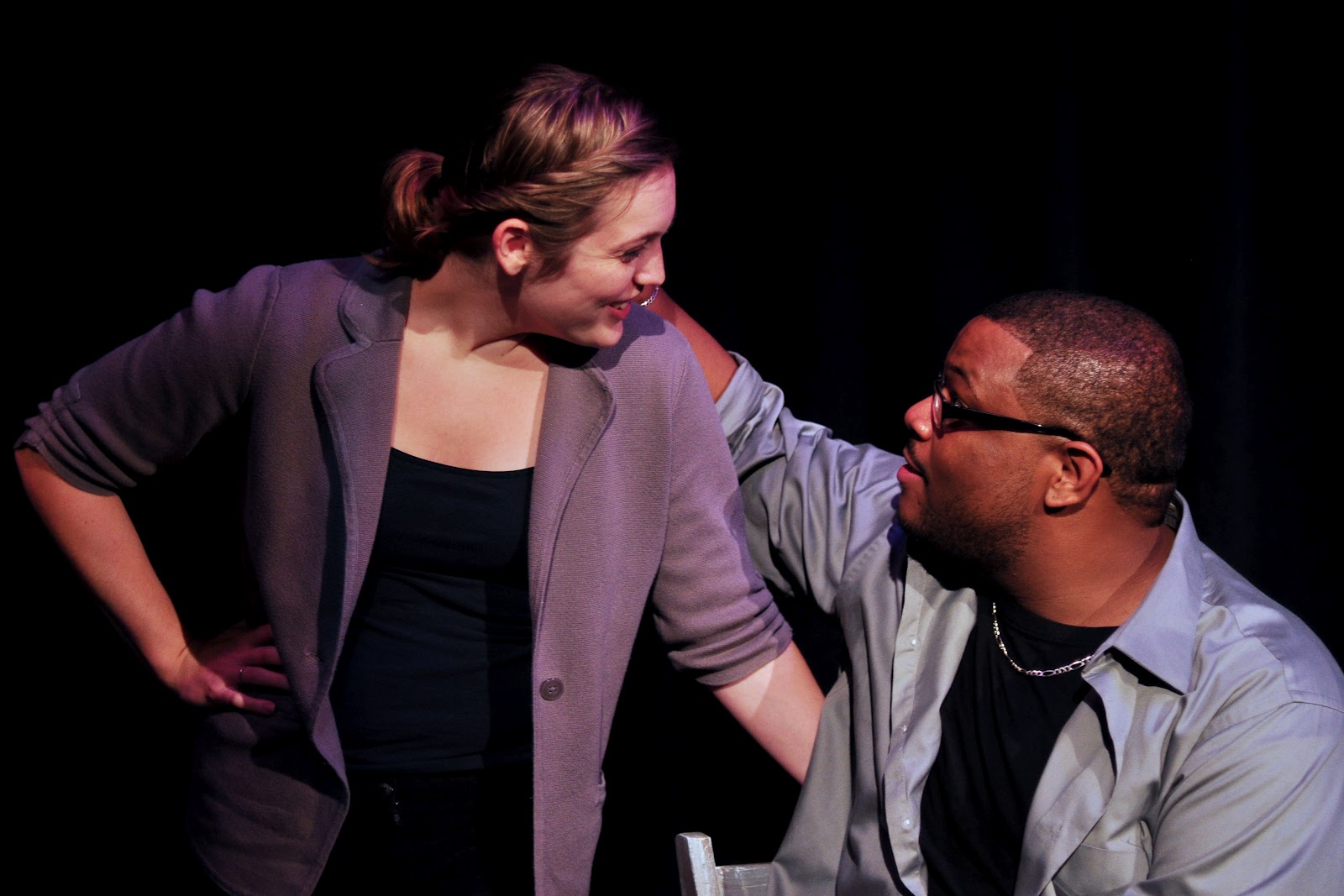
Take a look at the publicity pictures that were taken last Tuesday! See everyone tonight!


Wednesday, July 25, 2012

WEDNESDAY JULY 24


Wow! Two Acts in one night! IT was a push, but you got through it! Tonight will be more of the same: Act III followed by Act I.

You’re all doing a great job staying off book. I noticed that Act II was shakier than Act I, but this is to be expected. Keep pushing memorization. Did anyone else notice how much more polished Act I looked? This is because no one is really struggling for words. When you have a command of the words, you can gain a command of the emotions.

Beginning on Thursday, both Michel (Mrs. Soames) and Rita (Mrs. Webb) have travel plans that were made before they were cast. Desi, could you read in for Mrs. Soames? And Emily (Morris, not Webb), could you read in for Mrs. Webb? If the two of you are comfortable with blocking, you can cover their parts on stage. Otherwise, you can simply read it from the house.

HFAC’s Artistic Advisor Rob Urbinati saw your rehearsal last night and he was very complimentary of you all. Thanks for making such a good impression on him! I'm meeting with Rob tonight for dinner and he'll give me more detailed notes on the show. Katy will be guiding you through tonight's rehearsal.  

Fun fact #8: Chickens in Our Town

The Philo System is still available;
Amazon sells it for $14.99 plus shipping!
On p 48, Editor Webb mentions the Philo System for raising chickens. The Philo System of Progressive Poultry Keeping is a real book written by Edgar Philo and   published in 1908. As far as I can tell, as I have yet to find a concise summary, he seemed to advocate improved chicken management by informing readers of precise details of chicken management. He advocated, for instance, that chickens be kept in small flocks of 10 instead of large flocks of sixty. He noted that 10 hens would lay 60 eggs in 7 days, or one egg a day per week per hen with one day off. But a large coop of 100 chickens would not lay 600 eggs a week; they were too stressed. Dividing them back into small groups increased egg production to the fabled 600 eggs per week.

Perhaps this is what Julia Gibbs looked like when she fed her flock of chickens.


Tuesday, July 24, 2012

Program Bios

Everyone in the cast and crew can have their bio listed in the program.  In order for this to happen, YOU must write and submit your bio to Cheryl Mills, our HFAC Administrative Assistant and Program Editor.  Here are the specific instructions for bios.

Your bio can have a MAXIMUM of 400 characters, including spaces.  The easiest way to track the number of characters is to compose your bio in Word, and use the "statistics" functions to make sure you're within the character limit.  If you're at even 401 characters, Cheryl will edit your bio down to get under the character limit.  Please list previous shows in italics with the character played in parentheses, such as "Tracy has been seen in Guys and Dolls (Lt. Brannigan) and Willy Wonka (Mr. Salt)" instead of "Tracy recently played Lt. Brannigan in Guys and Dolls."  Please refrain from commercial endorsements in your bio ("Tracy owns XYZ Productions").

The deadline for bio submission is Friday, August 3, and should be emailed to cherylann1212@yahoo.com.  If you miss that deadline, your bio will NOT be in the program.  Don't be that person.  :-)

Any questions, shoot me an email at tracy.clayton@sbcglobal.net or call me at 281-840-8011.

Tracy


Monday, July 23, 2012

MONDAY JULY 23

Don't forget, NO REHEARSAL TONIGHT!

There is a directing workshop at HFAC by Rob Urbinati that I'm attending.

See everyone on Tuesday for Act I and II.

Thursday, July 19, 2012

Volunteers

Another great way for your family and friends to see the show for FREE is to volunteer as an usher for one or more shows.  It's really easy, and they'll get great seats to boot!  There are some age restrictions (minimum of 15 or 16 years old if memory serves).  If you know of someone who is interested, please have them contact our House Manager and Volunteer Coordinator, Carla Conover at pconover@entouch.net.  She can provide all of the necessary details.  Carla will only hold these spots for your family and friends for a couple of weeks before opening the list up to our regular volunteers, so don't delay!

Cast Ticket Sales

As I mentioned a few nights ago, you have the opportunity to offer a $4 discount off of the adult ticket price to your family and friends as well as an opportunity to earn free tickets that you can use as you see fit.  The easiest way to sell discounted tickets is to direct your friends and family to the ticket link for Our Town, which is https://houstonfac.secure.force.com/ticket#details_a0Sd0000000AdfJEAS.  Once they've selected the performance date and seats, they can enter the discount code HOWIEP (for premium seating locations) or HOWIE (for the last three rows in the Garza).  The codes are NOT case sensitive, and will apply a $4 per ticket discount off of the adult ticket price.  Note that the ticketing software adds a convenience fee of either $2 or $3 per ticket, depending on ticket type.

You can also sell tickets directly to your friends and family members, and they can save even more money!  All you have to do is collect $16 per ticket ($14 per ticket if they want to sit in the back three rows, which are non-premium seats), and then turn that money into me, and I will in turn give it to Cami Starks, our Box Office Manager, who will enter the tickets into the system.  Selling directly to your friends and family members also removes the per-ticket service fee, so they actually save either $6 or $7 per ticket, depending on seat location.  In addition, for every 10 tickets you sell directly, you recieve one free ticket that you can use however you wish.

I'll have the ticket sales forms available by Monday's rehearsal, but if you want to sell prior to that date, feel free to do so.  Just make sure that you get following information for each set of tickets sold:
  • Name to be left on tickets (all tickets are held at Will Call)
  • Number of tickets per person (ie. Tracy Clayton - 1; Lisa Garza - 4, etc.)
  • Performance date and time (if two shows that day)
  • Contact number and email address for ticket holder (used for ticket confirmation and problem resolution)
  • Collect $16 (Premium seat) or $14 (last three rows) per ticket (cash or check payable to HFAC, no credit cards)
Please let me know if you have any questions about the process.

Tracy

Wednesday, July 18, 2012

WEDNESDAY JULY 18


Note the following change: Music rehearsal this week has been moved from Wednesday night (tonight) from 7:00 to 7:30 to Thursday night. Well probably meet in the purple room again, so look for us there.

Sorry for the confusion on the blog yesterday. For some reason, I just had the wedding scene on my mind. And that’s what I focused on. Well, at least we’re ahead for today!

Last night went well. I can’t tell you how nice it is to have the entire cast available to complete a scene.  Please make sure to review your blocking before we run this scene again so that we don’t have to stop and figure out where your entrance is or where you need to stand. As the show evolves, note these things will shift around a bit. Not a lot, but perhaps a bit.

We’re going to pick up the pace next week by running TWO Acts per night instead of just one. This is what next week looks like:

Mon July 23: OFF (Run lines at home, particularly Act I and II!)
Tuesday July 24: Acts I and II (Off book for I and II, but you can call for lines)
Wednesday July 25: Acts III and I
Thursday July 26: Acts II and III

We’ll also have to squeeze in a few more music rehearsals here and there, but these should take no more than 30 minutes a piece.

Some of you have asked about costumes and why we will mime events from 1900 but wear contemporary clothing. I talked about this early on during rehearsal and on July 8 blog entry, but here’s a review:

Wilder wrote Our Town in 1937 and it premiered the following year. So the opening Act takes place a generation or two earlier than the present- 37 years to be exact. For comparison, if Wilder had written Our Town today, he would have set the opening Act in 1973. And while the clothes people wore in 1973 are certainly different from what we wear today, they wouldn’t look as foreign as waistcoats and bustles. The clothing would have been recognizable and relatable.

One of the things Wilder did was to throw theatre convention on its ear. He eliminated scenery, which made the audience LOOK at the actors more intently to imagine what was happening. We’re doing the same thing by tossing out dated turn-of-the-century costumes that are typically associated with Our Town. When people see floor length skirts and kids in knickers, it creates a distance. They begin to think that Our Town happened 100 years ago when people were different. Our world, they begin to think, is different today.

But you and I know that things today aren’t different. People still rush headlong through life, missing chances to really look at one another, losing out on making connections. I’d like all of you to look like present-day moms or dads or students or editors or professors or stage managers. That way, the moms, dads, and students in the audience start to see themselves.

Chances are, maybe half of our audience will have seen one version or another of Our Town before. It’s one of the most performed plays in America. But I want them to see Our Town in a new way beginning August 17, a version that includes them.

Fun Fact about Our Town #7
This fact isn’t fun, but it is important. On p 71, Mrs. Soames, after finding out that Emily has died in childbirth, says, “Childbirth! I’d forgotten all about that!” Perhaps she is referring to the joys of bringing a new life into the world. But she is also referring to how dangerous childbirth was back then.

Maternal mortality rates at the turn of the century were, ballpark, about 100 deaths per 100,000 pregnant women. In the 1800’s, these rates crept upwards of 40% in some areas. Getting pregnant was about the risky thing a woman could do in an era lacking blood transfusions and antibiotics. (US maternal mortality rates today vary from state to state, but a rate of 10 per 100,000 is close to average.)

Putting this into perspective, start counting kids in your school or kids of co-workers or kids in your church. Every time you get to 100, eliminate one mother. The cumulative effect could be quite profound. If your school has an enrollment of 1000, the "cost" would have been the lives of ten moms. Very sad.


Cemeteries at the turn of the century were full of the graves of mothers and their infants.